

Fast and eco-friendly analysis of harmful substances in food
Scientists have developed a faster and more environmentally friendly method for detecting hazardous chemicals in food products, which increases the accuracy and efficiency of food safety monitoring. This new approach could improve the quality and safety of food production.
Cursus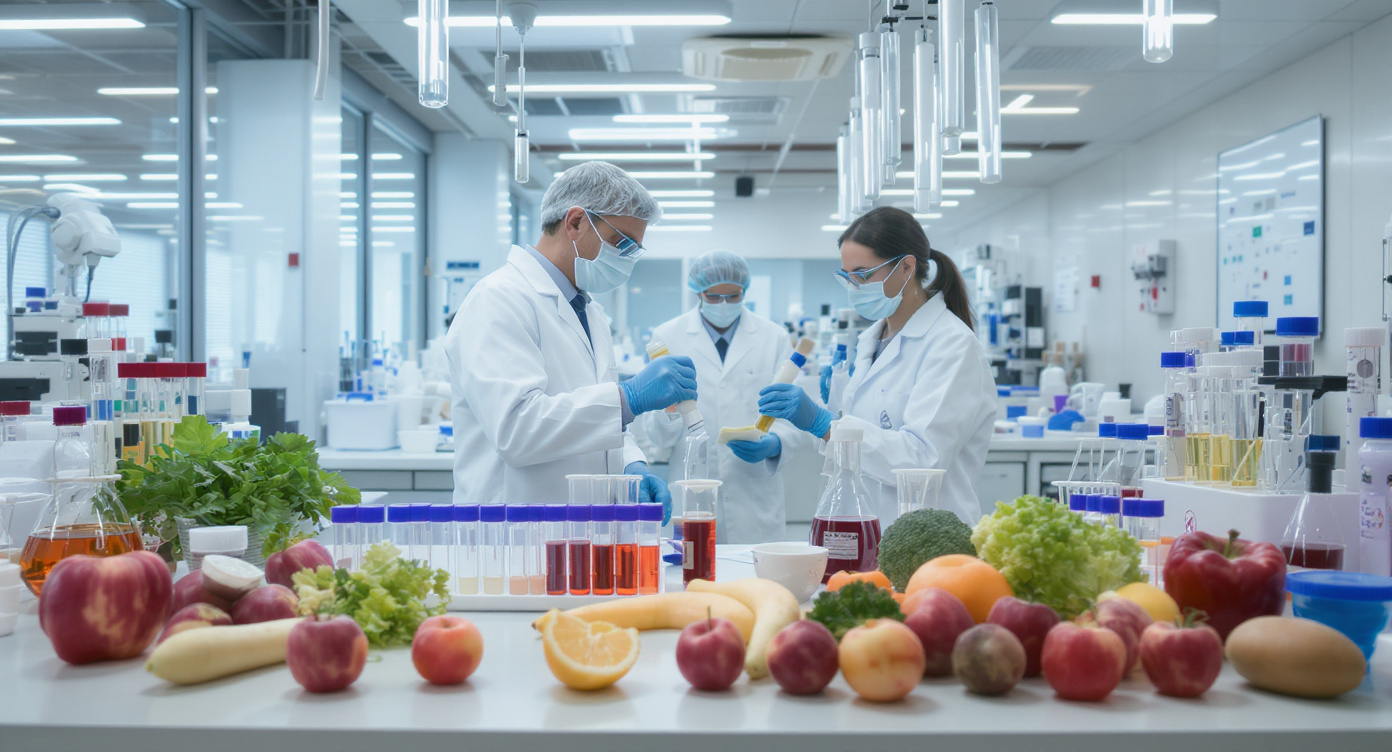
Researchers have introduced a faster and more environmentally friendly method for detecting harmful chemical compounds that can be found in everyday food products. This new approach is highly accurate and can make food safety testing significantly more efficient.
Relevance of the Issue
In today’s society, more and more people are concerned about their health and monitor their diets, using fitness apps and calorie-counting programs. As part of this trend, interest in nutrient-rich foods like fruits and vegetables is growing. However, even these foods can contain polycyclic aromatic hydrocarbons (PAHs)—hydrophobic organic compounds made up of several fused aromatic rings and their analogues. Contamination can occur due to environmental exposure or as a result of cooking processes such as heating, smoking, grilling, roasting, and other methods. Some PAHs are recognized as carcinogens, raising serious health concerns.
The Need for Accurate Analysis
Given the potential risks, it is crucial to accurately extract and identify PAHs in food products. Traditional extraction methods—such as solid-phase, liquid-liquid, and accelerated solvent extraction—are effective but often slow, labor-intensive, and less environmentally friendly. To address these challenges, scientists have turned to the QuEChERS method (Quick, Easy, Cheap, Effective, Rugged, and Safe), which is designed to simplify and speed up the extraction of organic compounds. This approach reduces processing time, increases accuracy and recovery rates, and streamlines sample preparation, enabling safer and more effective PAH analysis.
Research Results
A recent study conducted by a team from the Department of Food Science and Biotechnology at Seoul National University of Science and Technology, led by Professor Jun-Goo Lee, applied the QuEChERS method to measure eight types of PAHs (benzo[a]anthracene, chrysene, benzo[b]fluoranthene, benzo[k]fluoranthene, benzo[a]pyrene, indeno[1,2,3-cd]pyrene, dibenz[a,h]anthracene, and benzo[g,h,i]perylene) in food products. Acetonitrile was used for PAH extraction, and various combinations of sorbents were employed for sample purification. Across different food matrices, the QuEChERS method demonstrated stable and reliable results. Calibration curves for all eight PAHs showed excellent linearity, with a determination coefficient (R²) above 0.99.
Analysis using gas chromatography–mass spectrometry revealed detection limits ranging from 0.006 to 0.035 μg/kg and quantification limits from 0.019 to 0.133 μg/kg. Recovery rates were also high: from 86.3 to 109.6% at 5 μg/kg, 87.7 to 100.1% at 10 μg/kg, and 89.6 to 102.9% at 20 μg/kg, with precision ranging from 0.4 to 6.9% for all tested food matrices.
Advantages and Future Prospects
Professor Lee notes, “This method not only simplifies the analytical process but also demonstrates high detection efficiency compared to traditional techniques. It can be applied to a wide range of food matrices.”
In the food industry, adopting this method could lead to more effective safety control and improved overall quality management. Additionally, it can help reduce operational costs and enhance worker safety.
“Our research can contribute to public health by ensuring the safety of food products. Moreover, it reduces the use and disposal of hazardous chemicals during laboratory testing,” Professor Lee concludes.
Overall, the study confirms that the QuEChERS-based PAH analysis technique is fast, accurate, and environmentally sustainable.