

The statues of Easter Island were created by rival communities
A new study has revealed that the famous statues of Easter Island were not created by order of a single chief, but by various independent communities that competed with one another. This finding changes our understanding of the island's history and the reasons behind its decline.
Cursus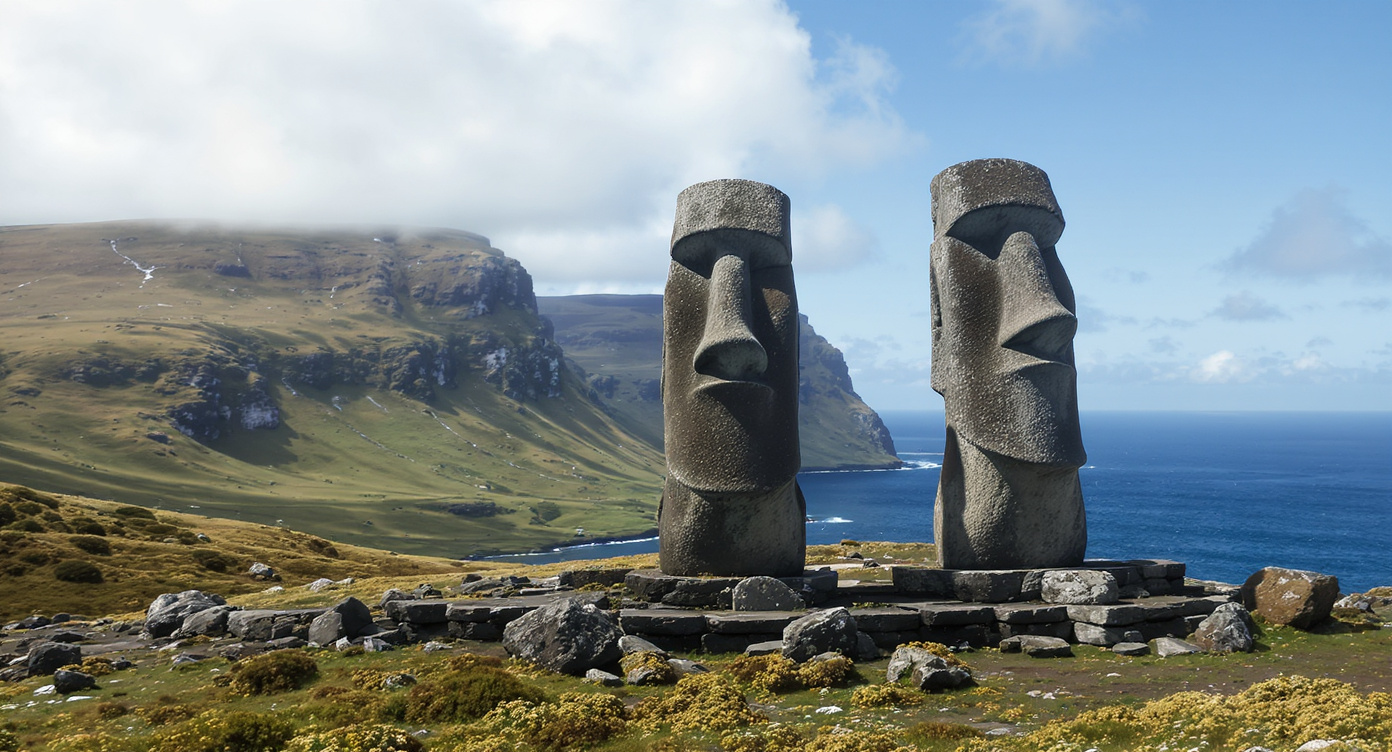
For a long time, it was believed that the hundreds of giant statues on Easter Island were created by the local inhabitants under the leadership of a single chief. However, new research is challenging this theory. A 3D map of the island’s main quarry has revealed that the process of creating the statues was much more complex: it is now thought that the monuments were the result of creativity and competition among several small, independent groups.
Easter Island: Geography and History
Easter Island, also known as Rapa Nui, is one of the most remote inhabited islands on Earth. The nearest populated land, the Pitcairn Islands, is almost two thousand kilometers away. According to archaeological evidence, the first people arrived on the island between the 12th and 13th centuries.
The Mystery of the Moai Statues
The island’s main attraction is the monolithic stone moai statues, which depict human figures. They were created between the 13th and 17th centuries, and today more than 900 such statues are known. The average height of a moai is about four meters, and many weigh over 12 tons. Almost all were carved from volcanic tuff in the Rano Raraku crater, then transported and erected on stone platforms (ahu) in various parts of the island.
Moai are generally considered to represent the “frozen faces” of revered ancestors, chiefs, or important clan members. It is believed that the statues symbolized and immortalized power and lineage, and also served as guardians and sources of spiritual energy (“mana”) for the community.
Who Created the Moai?
For a long time, scholars debated who oversaw the construction of the statues and how the small population managed to organize such large-scale work. The popular theory suggested centralized leadership by a single ruler. However, some researchers noted that the moai differ greatly from one another, as if they were made by different craftsmen.
To solve this mystery, a team of scientists led by Carl Lipo from Binghamton University (USA) analyzed the island’s main quarry—Rano Raraku. Using drones and photogrammetry, they created the first detailed 3D model of the quarry, allowing them to study every slope and trace of ancient craftsmanship.
New Discoveries
The researchers documented 426 moai at various stages of completion, 341 trenches cut around stone blocks, 133 empty niches in the rock where statues had already been removed, and five stone pillars that served as anchor points for ropes to carefully lower the statues down the slope.
Analysis of the 3D model showed that the quarry was divided into 30 separate work zones. In each zone, Lipo’s team found unique carving techniques and stone-working features specific to that part of the quarry.
Lipo explained that all stages of statue creation—from the first cut to the final touches—took place within a single zone. This setup resembles a network of independent workshops rather than a centralized system where statues would move from one division to another, like in a factory.
Decentralized Production
The new data fits well with what is already known about life on Easter Island. Previously, the same team demonstrated that transporting the massive moai did not require the labor of thousands: just a few people could “rock” the statue from side to side and literally “walk” it forward using ropes. In other words, moving the statues did not require centralized leadership or vast human resources.
There is further evidence supporting decentralized production. For example, sources of fresh water on the island did not belong to a single power center—different communities shared them among themselves.
A New Interpretation of the Island’s History
All these facts indicate that Easter Island was home to several communities that not only sometimes helped each other but also competed among themselves. According to Lipo, creating moai was a way for each group to demonstrate its strength and express its identity, rather than simply following the orders of a powerful ruler.
This version also changes the narrative of the “fall of Rapa Nui.” Previously, it was believed that a unified elite under a single leader forced people to build moai, leading to deforestation and resource depletion, which caused the collapse of society. Lipo considers this version incorrect: according to his findings, there was no single authority, and each community worked independently on statue creation. They did this not by command, but out of a desire to stand out and surpass their neighbors. In this model, there is no central figure to blame for the disappearance of the forests and the subsequent catastrophe.
The scientific study was published in the journal PLOS One.