

Solar Mobile Clinic for Remote Regions
Students from Eindhoven University of Technology have developed a prototype of a solar-powered mobile clinic designed for remote and hard-to-reach areas. Stella Juva is equipped with state-of-the-art medical equipment and is currently being tested in Africa to provide access to healthcare without the need for infrastructure or emissions.
Ingenium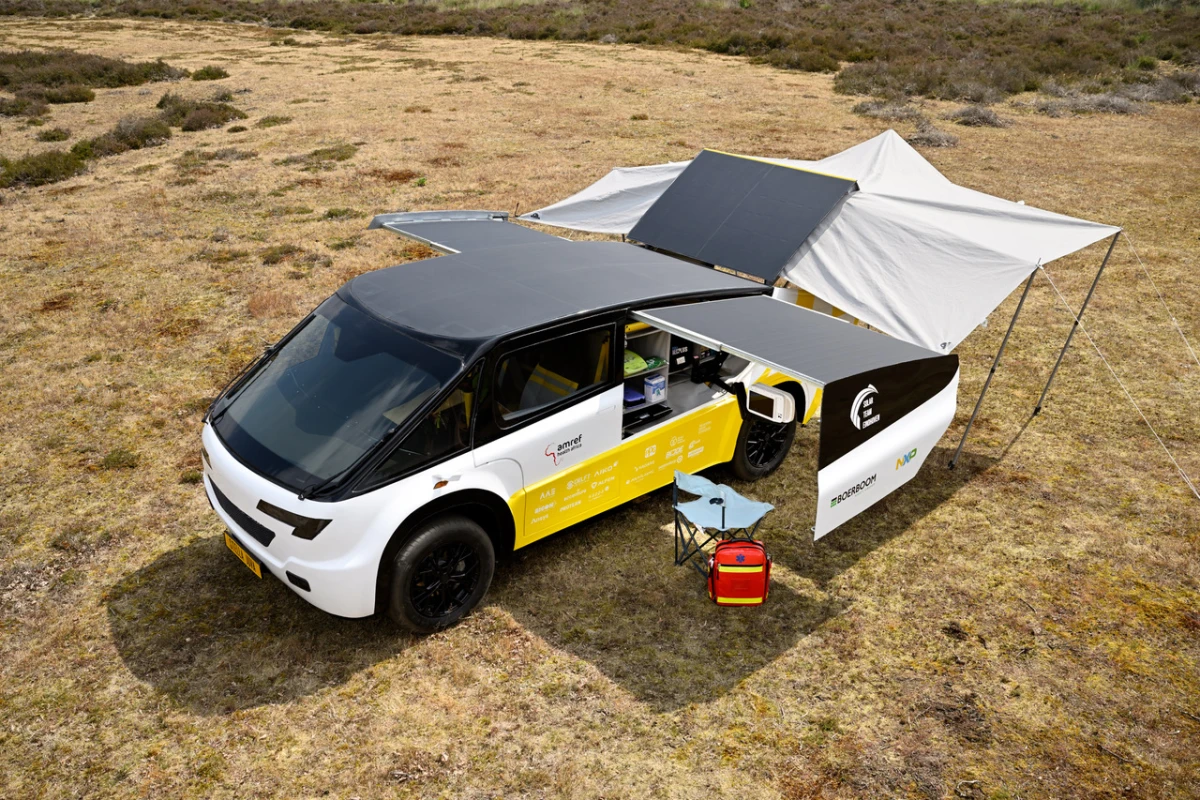
Engineering students from Eindhoven University of Technology have developed a transport vehicle designed to provide medical assistance in remote regions lacking developed infrastructure. The prototype, named Stella Juva, runs entirely on solar energy and will soon undergo testing in Africa.
Design and Technology
The Solar Team Eindhoven has previously worked on various solar-powered vehicles, including family cars and off-road vehicles. Their new project is focused on the humanitarian sector and represents an autonomous mobile clinic intended for use outside urban environments.
The main goal is to provide access to medical infrastructure for approximately one billion people living in areas without roads, electricity, or fuel. To achieve this, the vehicle uses advanced All Back Contact photovoltaic cells from AIKO, where all electrical contacts are placed on the back of the cells, allowing for maximum efficiency even in partial cloud cover. The panels feature integrated copper connections and silver-free technology, which increases durability and reduces the risk of damage from vibrations on rough terrain.
The solar roof charges a 50 kWh lithium battery, ensuring enough energy for nighttime operation or during extended periods of bad weather. The vehicle’s electrical architecture separates power supply between the drive system and the medical compartment, guaranteeing that medical equipment remains operational even if the drive battery is fully depleted. Pure sine wave inverters are used to protect sensitive equipment.
Technical Specifications
The vehicle weighs 1,350 kg thanks to a body and chassis made from aerospace-grade carbon fiber, making it significantly lighter than standard ambulances (which weigh between 3,500 and 6,350 kg).
The teardrop-shaped aerodynamic profile reduces air resistance.
On a single solar charge, the range is up to 715 km, with a top speed of 120 km/h.
Equipment and Functionality
Inside the climate-controlled medical compartment, the equipment runs on solar energy: a specialized X-ray machine for tuberculosis diagnostics, an ultrasound device for prenatal examinations, rapid malaria tests, and automated defibrillators. A high-efficiency refrigerator keeps vaccines and medicines at the required temperature, even in extreme heat.
Prospects and Testing
Stella Juva was created as a university project with open engineering blueprints and is not intended for mass production. The prototype demonstrates the possibility of creating medical transport that is emission-free and independent of existing infrastructure. The project relies entirely on external funding, including corporate sponsors, academic support, and partnerships with non-profit organizations.
Every two years, the student team develops a new solar vehicle. Their previous projects have won the World Solar Challenge in Australia four times in the family car category, and in 2021, they built the solar-powered motorhome Stella Vita, which traveled from Eindhoven to the southernmost point of Europe. In 2023, another prototype completed a 1,000 km journey from northern Morocco to the Sahara.
This month, field tests of Stella Juva will begin in Kenya in collaboration with the humanitarian organization Amref Health Africa. The vehicle will be tested in real medical scenarios on challenging terrain to collect data on its effectiveness in rural areas.