

Scientists have uncovered the mystery of the wandering lights of the marshes.
An international team of scientists has proposed a new explanation for the mysterious will-o'-the-wisps: their appearance is linked to microlightning—tiny electrical sparks between methane bubbles that produce a cold glow. This discovery paves the way for further research into this natural phenomenon.
Cursus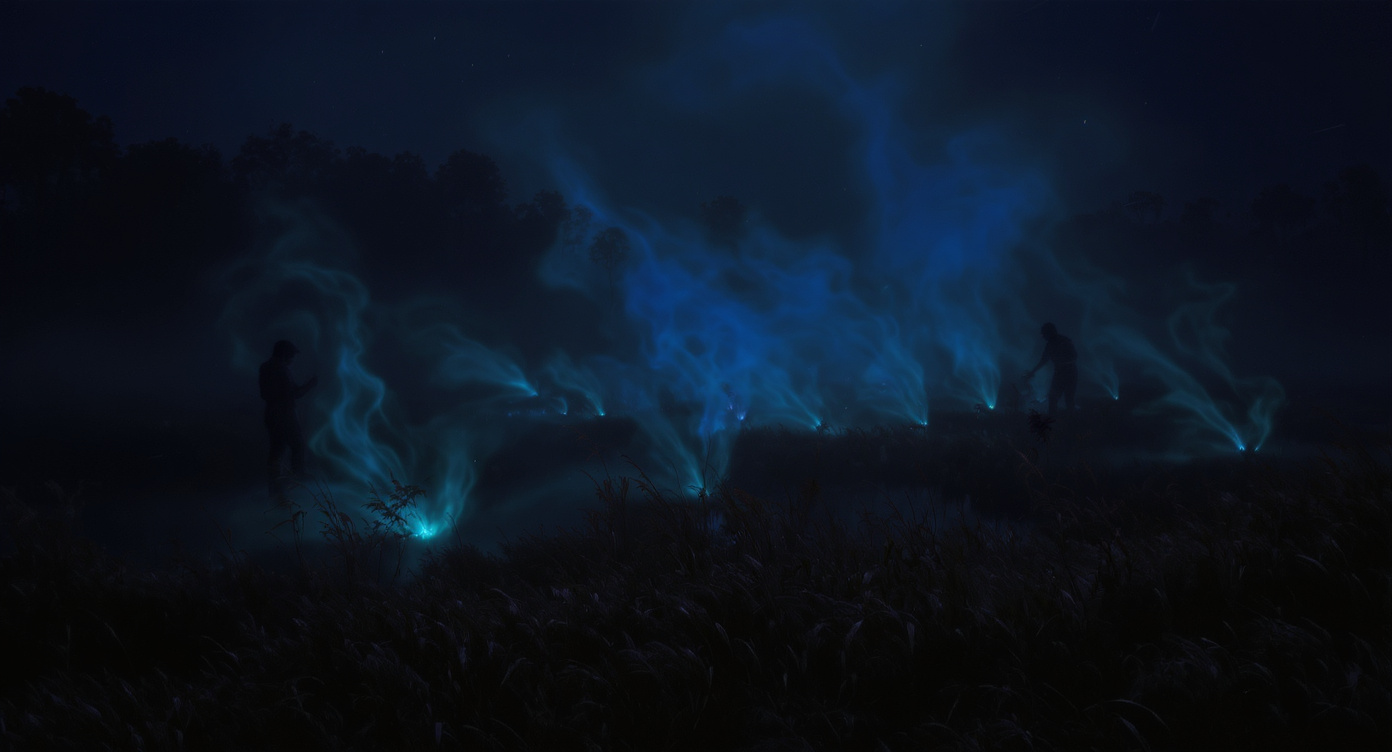
For centuries, mysterious lights that seem to dance above marshes have inspired fear among superstitious people and given rise to countless legends about sinister spirits luring travelers into deadly bogs. The scientific community has long sought to explain this unusual phenomenon and prove that its cause lies not in mysticism, but in natural processes. Recently, an international team of physicists and chemists may have come closer to unraveling the true nature of these enigmatic flashes of light.
The Nature of Will-o'-the-Wisps
Will-o'-the-wisps, also known as marsh or ghost lights, are a rare natural phenomenon most often observed at night over swamps. These blue or pale lights appear and vanish silently, which has traditionally been linked to supernatural forces—such as the souls of sinners, ghosts, or forest spirits. A scientific explanation for this phenomenon emerged much later.
Researchers have suggested that the glow is caused by the combustion of gases released during the decomposition of organic matter in swamp mud. The main "suspects" have been methane and phosphine. However, for a long time, it remained unclear how these gases could ignite above the water's surface. Hypotheses involving static electricity or lightning strikes lacked convincing evidence and could not account for all instances of the lights, leaving room for both mysticism and scientific debate.
A New Explanation: Microlightning
A breakthrough in the study of this phenomenon was achieved by a team led by Richard Zare from Stanford University (USA). The scientists focused on the properties of ordinary water. Previous studies had noted that microscopic water droplets can accumulate electric charge and create tiny sparks. This led to the idea that something similar might happen with gas bubbles.
In laboratory conditions, the researchers passed microbubbles of methane and air through water, recording the process with a high-speed camera, photon counter, and spectrometer. They found that as methane bubbles rise to the surface, they deform and rub against each other and the water, accumulating electric charge. When two charged bubbles merge, the difference in potential between them becomes so great that a miniature electric spark occurs—a phenomenon they called "microlightning."
The Mechanism of the Glow
The scientists not only observed flashes between the bubbles but also analyzed their spectra. The spectral composition matched the emission typical of excited molecules and radicals involved in oxidation processes. In other words, microlightning generates enough energy to excite gas molecules and trigger their "glow."
Zare and his colleagues discovered that underwater microlightning initiates the oxidation of methane by forming excited molecules and radicals. As the bubbles rise, the reaction continues near the surface and manifests as a visible cold glow. This is a low-temperature chemical reaction that produces visible light and releases heat—a so-called "cold" form of oxidation.
Simply put, the process triggered by microlightning occurs right at the water's surface. When a bubble reaches the boundary between water and air, the reaction appears as a visible flash of cold light. This glow is perceived by observers as a "will-o'-the-wisp," while the spark between bubbles underwater acts as a kind of "ignition."
Scientific Community's Assessment
The scientific community has responded positively to Zare's team's work, though with some caution. According to experts, the proposed mechanism can explain many cases of marsh lights, especially where methane is present. However, it is too early to consider it universal, as in some situations other factors—such as phosphine or other chemical and physicochemical processes—may play a role. Nevertheless, this discovery encourages further research and experimentation.
The results of the study have been published in the journal PNAS.