

A laser controls microgears using metastructures.
Scientists have developed a method to control the rotation of miniature silicon gears using lasers and metastructures, opening up new possibilities for micromechanics and medicine. This technology enables such components to be integrated directly into chips and operated without physical contact.
Ingenium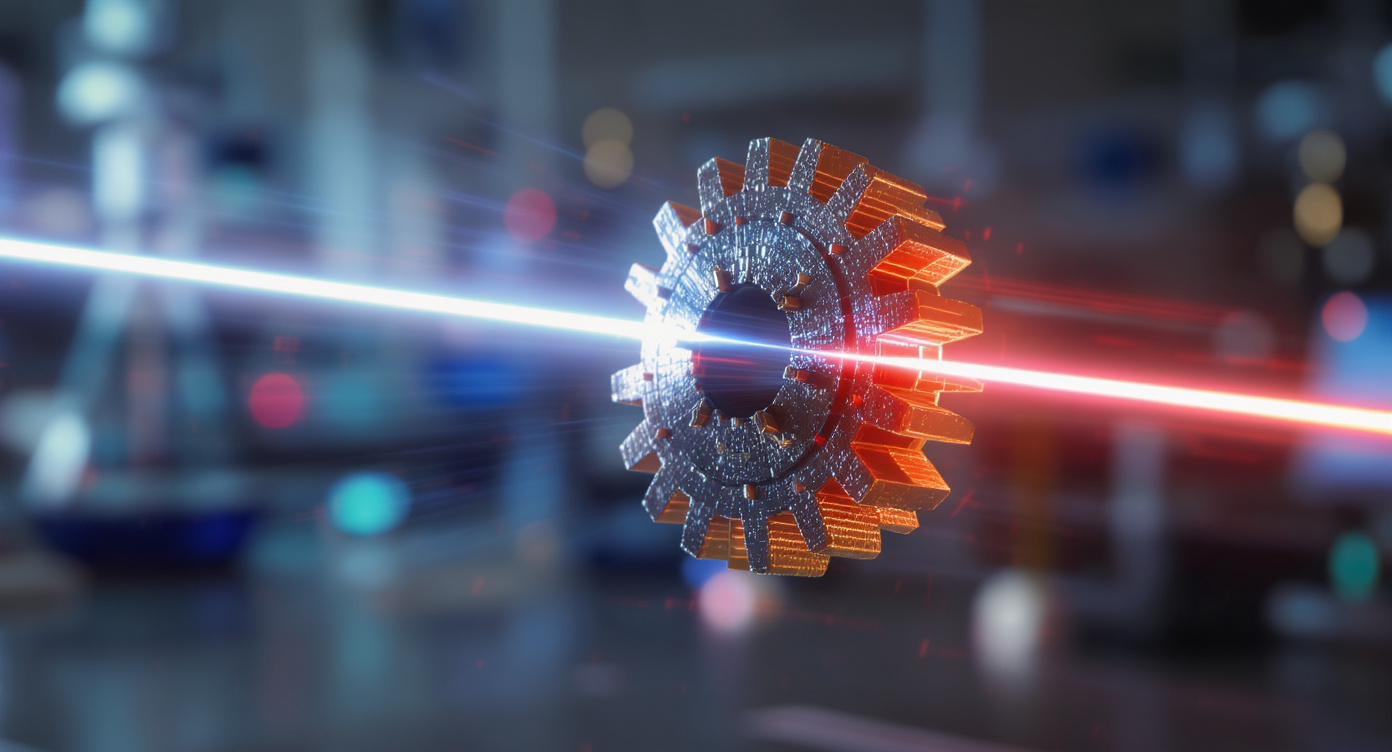
Scientists have developed a method to control the rotation of a silicon gear using a laser by coating its surface with a special metastructure.
Miniaturization of Gear Mechanisms
Gears and cogs are widely used in a variety of devices—from watches and cars to hydroelectric plants and children's toys. They are essential for transmitting torque between parts of mechanical systems. Engineers and researchers are constantly striving to reduce the size of gears to create micro-motors. However, until now, the minimum size of such components was limited to about 0.1 millimeters, as it was impossible to make drive mechanisms any smaller.
A Breakthrough in Micromechanism Control
An international team of scientists has overcome this barrier by moving away from traditional mechanical drives. Instead, they proposed using a laser to set miniature gears in motion. To achieve this, they applied a metastructure—a specially nanostructured surface capable of interacting with light—onto the surface of the gear. The results of their research were published in the journal Nature Communications.
How Optical Metamaterials Work
Optical metamaterials are surfaces with regular nanostructures that can capture and control light at the nanoscale. Thanks to carefully calculated resonances within the metastructure, scientists can precisely manage optical processes. Such structures are the basis for developing, for example, "invisibility cloaks" for various ranges of radiation.
Experiment: Laser Drives the Gear
During the experiment, researchers fabricated gears with diameters of several tens of micrometers on a chip using lithography. Some of these gears were coated with metastructures. When the device was illuminated with circularly polarized laser light at a wavelength of 1064 nanometers and a power of 88.5 microwatts per square micrometer, they succeeded in making the gear rotate. The rotation speed was controlled by the laser's intensity, while the direction depended on the light's polarization. Thus, bulky mechanical connections were replaced by light-based control.
Advantages and Prospects of the Technology
As noted by the study's lead author, Gan Wang, the developed transmission allows a single gear, driven by light, to set an entire chain in motion. Such miniature mechanisms can convert rotational motion into linear motion, perform periodic movements, and control microscopic mirrors to direct light beams.
The ability to integrate such components directly into a chip and control them with light opens up new possibilities for creating complex moving microsystems. Using a laser eliminates the need for physical contact with the mechanism, making it easier to scale the technology.
Potential Applications
The size of these new gears is comparable to that of some human cells, making medicine one of the most promising fields for this innovation.