

Magnetic fields around the M87 black hole have changed dramatically
New observations have revealed that over the course of four years, the magnetic fields surrounding the supermassive black hole at the center of the M87 galaxy have completely changed direction. This unexpected discovery offers deeper insight into the dynamics and nature of black holes.
Cursus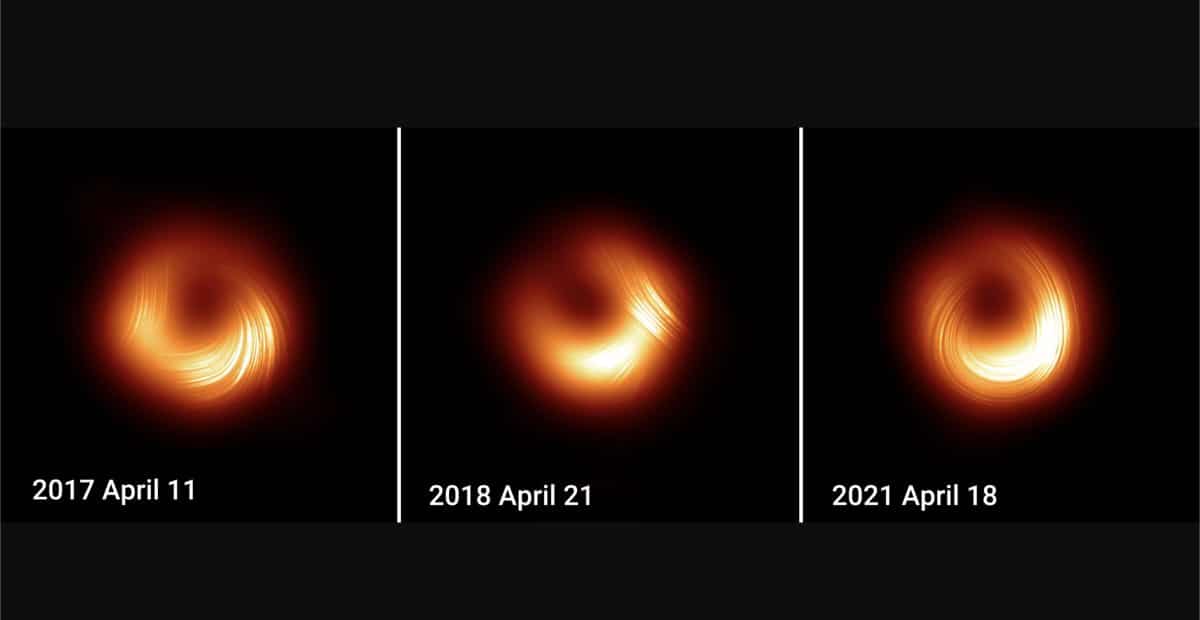
New images of the supermassive black hole at the center of the M87 galaxy have revealed that over the past four years, the magnetic fields in its vicinity have changed direction. This unexpected and significant discovery for understanding the nature of cosmic "monsters" became possible thanks to the Event Horizon Telescope (EHT) network of radio telescopes.
M87 Black Hole: The First Image and Its Importance
The M87 galaxy is located about 55 million light-years from Earth. Its central black hole became world-famous as the "first photographed" black hole—although, in reality, the iconic image published on April 10, 2019, captured only the shadow of the black hole against the backdrop of its accretion disk. The mass of this object is estimated at around 6.5 billion solar masses, and it is surrounded by a bright ring of matter spinning at tremendous speed around the event horizon.
The Accretion Disk and Relativistic Jets
The black hole’s accretion disk is a powerful source of radiation, especially radio waves. From its poles, gigantic streams of plasma—so-called relativistic jets—emerge, stretching for thousands of light-years. Previously, scientists comparing observations of the M87 core from 2017 and 2018 found that in just one year, dense clumps of matter in the accretion disk shifted by about 30 degrees, and the jet itself began to gradually change direction.
Magnetic Fields and Gamma-Ray Flares
Astronomers are also interested in the powerful gamma-ray flares observed near M87, which are believed to be linked to the magnetic field of the accretion disk. Changes in this field are detected by measuring the polarization of the emitted radiation—that is, the alignment of electromagnetic wave oscillations coming from the disk and the corona around the black hole. These data are also collected using the Event Horizon Telescope.
Unexpected Changes in Magnetic Fields
An international team of astronomers led by Kazunori Akiyama from the Massachusetts Institute of Technology analyzed data from 2017, 2018, and 2021 and discovered unexpected changes in the polarization of the radiation. Over four years, the magnetic fields near the event horizon completely reversed direction. In 2017, the fields twisted in one direction, stabilized in 2018, and by 2021, their orientation had fully flipped. This came as a surprise to researchers, as it was previously thought that magnetic fields under such extreme conditions should be more stable. The observed dynamics are likely influenced by both external factors (such as changes in polarization as light passes through interstellar space) and internal processes within the plasma itself.
"The plasma at the event horizon is far from static. Its complex 'behavior' forces us to rethink existing models," note the study’s authors.
New Opportunities for Studying Jets
In 2021, after connecting the 12-meter radio telescope at Kitt Peak Observatory (USA) and the French NOEMA interferometer to the EHT network, scientists were able for the first time to detect radiation at the base of the jet, where the accretion disk connects to interstellar space. This significantly improved the sensitivity and clarity of the resulting images, allowing researchers to constrain the jet’s parameters at its origin—something that was previously impossible. This is crucial, as relativistic jets have a major impact on galaxy evolution: they slow down star formation and distribute energy across vast distances.
The Significance of New Observations
The supermassive black hole at the center of M87 emits across the entire spectrum—from radio waves to gamma rays—making it an ideal object for studying such processes. The authors of the article emphasize that these new observations not only complement the existing picture but also help build a more complete understanding of black hole physics—some of the most mysterious objects in the Universe.