

A visible time crystal has been created for the first time.
Physicists have, for the first time, directly observed time crystals in the optical range using liquid crystals. This discovery could lead to new methods of marking and advances in quantum technologies.
Cursus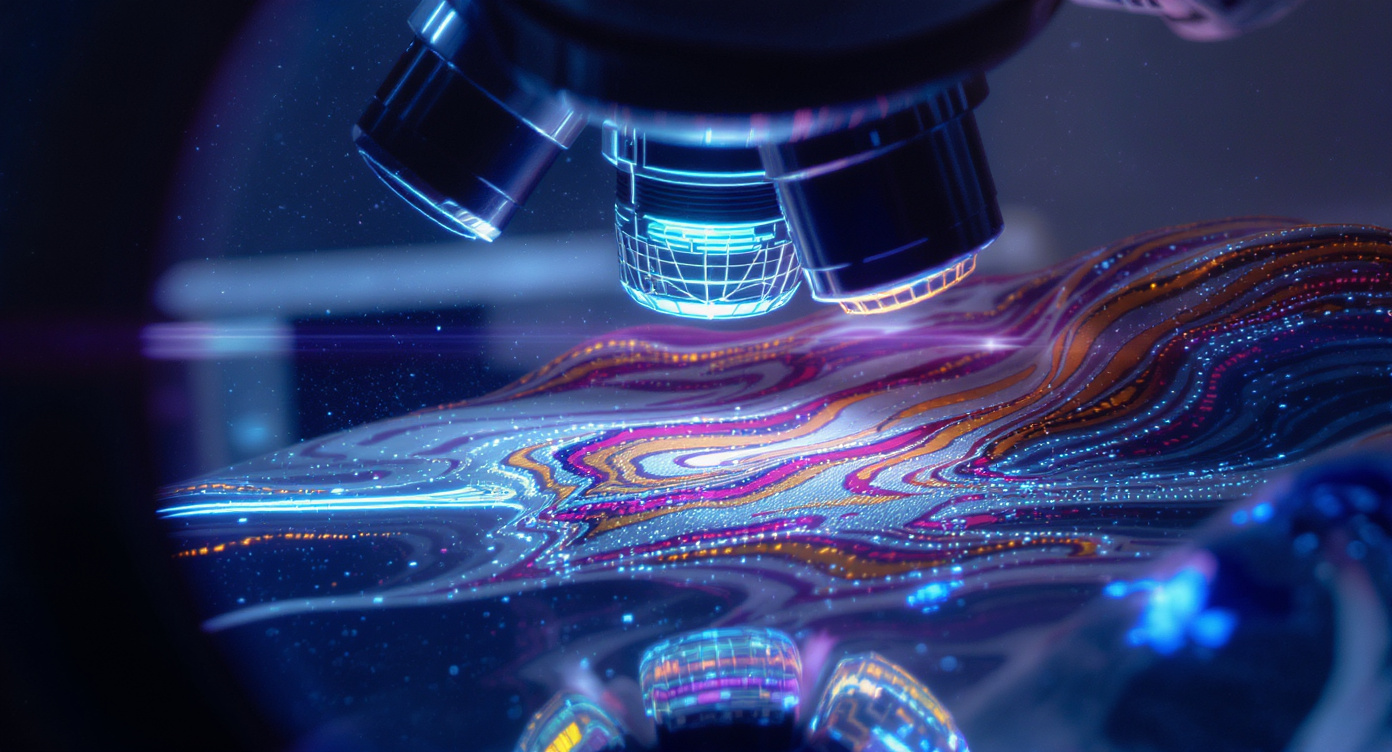
For the first time, scientists have managed to create a time crystal visible in the optical range using liquid crystals.
What are crystals and time crystals?
Ordinary crystals are solid materials with a periodic internal structure. Their properties depend on their composition, shape, and the arrangement of their basic units. For example, both graphite and diamond are made of carbon, but their structures differ: you can write with graphite, while diamond can cut through stone.
Time, or temporal, crystals are unique in that their internal structure repeats not only in space but also in time. Such quantum systems can be imagined as a looping short video or a gif animation. The concept of time crystals was proposed by Nobel laureate Frank Wilczek in 2012, and in 2017, two independent research groups created such structures and published their results in the journal Nature.
A breakthrough in observing time crystals
Previously, the existence of time crystals was confirmed only indirectly—through spectroscopy and measurements of quantum states. In a new study, physicists were able to directly observe time crystals under an optical microscope. Their work was published in the journal Nature Materials.
How visible time crystals were created
For the experiment, scientists developed glass cells filled with liquid crystals. The molecules of these crystals are rod-shaped, behave like a liquid, but can form ordered structures. When compressed correctly, the molecules cluster together and begin to bend.
Professor Ivan Smalyukh notes: “These twists cannot simply be removed from the system. They behave like particles and start to interact with each other.”
During the experiment, the liquid crystal solution was placed between two glass plates coated with dye molecules. When exposed to light, the dye molecules changed orientation and compressed the liquid crystals, leading to the formation of new bends.
Observations and properties of time crystals
The resulting bends began to interact with each other. Under the microscope, the crystals looked like “psychedelic tiger stripes” and moved for several hours. However, this movement is not perpetual: the system receives energy from outside, and without directed light, the motion stops.
The movement patterns proved to be very stable—the researchers could change the temperature of the samples without disrupting the motion of the liquid crystals.
Smalyukh emphasizes: “This is the beauty of a time crystal. You simply create certain conditions, shine light on the crystal—and everything happens on its own.”
Potential applications
Scientists believe that time crystals could have various applications. For example, they could be used for marking and verifying the authenticity of banknotes. Additionally, combining time crystals with Majorana fermions could lead to the creation of more reliable and simpler quantum computers.