

Rice eliminates pests using a trap mechanism.
American scientists have discovered that rice defends itself against caterpillars by luring them inside its spikelets, where special hairs trap them, making escape impossible. Then, the grain husks close in and fatally crush the pests. This natural defense mechanism could help develop new varieties of cereals that are resistant to insects without the need for chemical pesticides.
Agros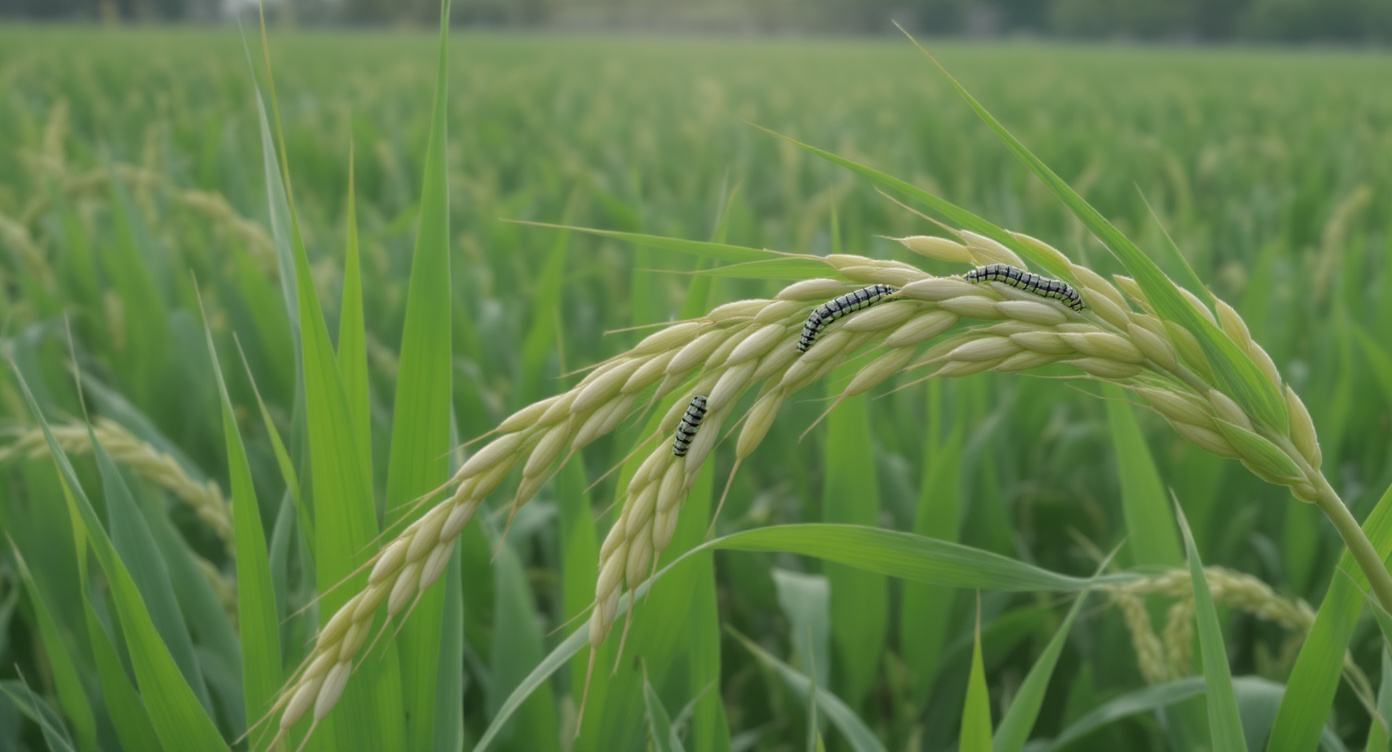
American researchers have discovered an unusual physical defense mechanism in rice that allows the plant to destroy fall armyworm caterpillars. It was found that rice lures pests inside its spikelets, where tough microscopic hairs (trichomes) prevent the insects from escaping. Then, as the grain husks close, they crush the trapped caterpillar, leading to its death.
Pest Characteristics and Rice Defense Structures
The fall armyworm (Spodoptera frugiperda) is a dangerous agricultural pest known for developing resistance to chemical insecticides. The caterpillars of this species feed voraciously on the leaves and young ears of various crops, including rice. Plant leaves are known to be covered with trichomes—stiff hairs that make it difficult for insects to move and feed. In rice, these hairs densely cover not only the leaves but also the spikelets.
Experimental Studies
During laboratory and greenhouse experiments, caterpillars were offered a choice between rice spikelets at the flowering stage (with partially open flowers) and at the grain ripening stage. In some trials, insects also had access to fresh leaves. At the same time, researchers used gas chromatography to analyze the chemical composition of volatile substances released by the plant. Insects that died during the experiments were examined using an electron scanning microscope.
The Trap Mechanism
It was established that during flowering, rice spikelets emit a specific blend of aromatic compounds, including dodecane and ethylhexanal, which attract caterpillars more strongly than the scent of ripening grain. Drawn by this lure, the caterpillar crawls into the partially open flower, where a dense layer of trichomes, angled in a particular direction, allows it to move forward but blocks its retreat—the hairs embed into the body and prevent escape.
After pollination, the rice flower closes to protect the developing ovary. Electron microscopy showed that the closing husks crush any caterpillars trapped inside, as evidenced by deformed and flattened insect head capsules in the images.
Effectiveness and Significance of the Mechanism
This defense method proved effective: between 50 and 53% of young caterpillars were trapped and died within 48 hours, even when they had access to regular leaves. Unlike carnivorous plants such as the Venus flytrap, rice does not digest its victims—the dead caterpillars simply dry out inside the spikelet. This mechanism serves solely as a defense, protecting the developing seeds from being eaten.
Application Prospects
Understanding this defense mechanism could be valuable in agronomy. Plant breeders may be able to develop new cereal varieties with specific trichome density and angle on the spikelets, enabling effective physical pest control and reducing the need for toxic chemical pesticides.