

Ancient priests transformed ergot into a safe elixir.
A new study has shown that ancient Greek priests were able to transform poisonous ergot into a safe psychoactive drink using ash and water. This suggests that people had access to complex chemical processes long before the advent of modern chemistry, although there is still no archaeological evidence to confirm this.
Cursus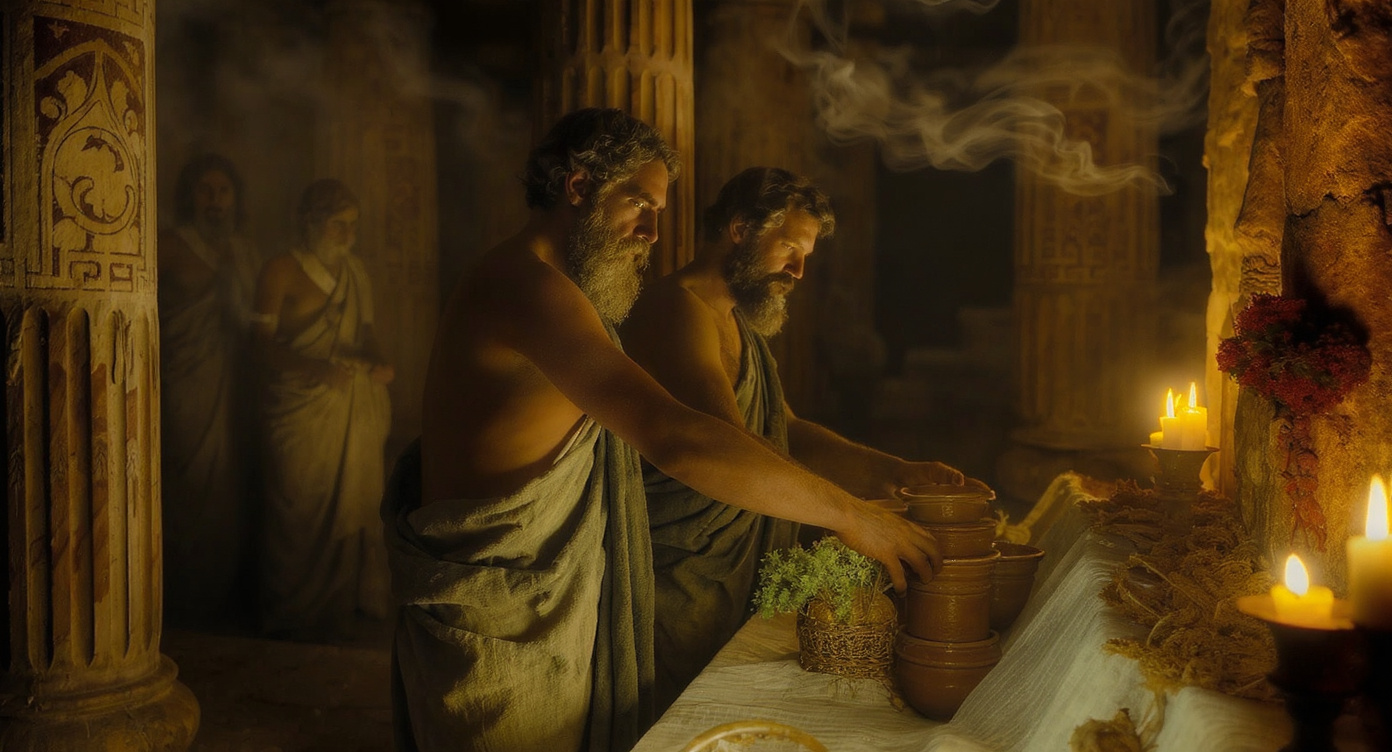
For nearly two thousand years in Ancient Greece, the Eleusinian Mysteries were among the most significant religious events. The climax of these rituals was the consumption of a drink called kykeon, which, according to historical records, was made from water, barley, and mint. The details of what occurred inside the temple were kept strictly secret, but there is evidence that participants experienced profound mystical states and altered consciousness.
In the 1970s, a hypothesis emerged suggesting that the psychoactive component of kykeon could have been ergot—a fungus that infects grains and from which LSD was later synthesized. It is known that ergot contains toxic alkaloids—ergot peptides—that can cause severe poisoning (ergotism), accompanied by gangrene, convulsions, and hallucinations. Critics of this hypothesis have pointed out that there are no records of mass poisonings among participants of the Mysteries.
An international team of scientists conducted a study to determine whether ancient priests could have used the technologies available to them to transform poisonous ergot into a safe psychoactive elixir, avoiding toxic effects. In their experiments, they burned oak and olive wood to produce ash, which was then used to make an alkaline solution (lye). Crushed ergot was boiled in this solution, with variations in boiling time, fungus concentration, and alkalinity levels.
A total of 48 experiments were conducted. The resulting extracts were analyzed using modern methods such as nuclear magnetic resonance and liquid chromatography-mass spectrometry, allowing for precise determination of the drink’s chemical composition.
The results confirmed that boiling ergot in strong lye for at least two hours completely destroys the toxic ergot peptides. In their place, psychoactive compounds—lysergic acid amide and its isomers—appear in the solution. These substances have effects similar to LSD, though they are less potent. The life-threatening compounds that cause gangrene disappear entirely. The researchers also found that the initially caustic lye is neutralized during preparation by carbon dioxide from the air and the addition of ergot powder, and is then mixed with the decoction, making the drink safe for consumption.
Thus, it was demonstrated that ancient priests could have successfully detoxified ergot using ash and water, turning it into a safe beverage. The study also confirms that complex chemical transformations were accessible to humanity long before the advent of modern chemistry.
However, despite the chemical feasibility of transforming ergot into a drink, it remains a hypothesis that ancient Greek priests deliberately collected infected grain and knew the exact proportions and boiling times needed to achieve the desired effect. So far, no archaeological evidence has been found to support this theory. The question of the strength and nature of the elixir’s impact on the human psyche in the context of ancient rituals also remains open.