

Zebra finches maintain their color preferences despite group influence.
The experiment showed that male zebra finches can maintain their individual color preferences when building nests, even if most of their peers choose a different color. The key factor is the balance between personal preferences and the influence of the group.
Cursus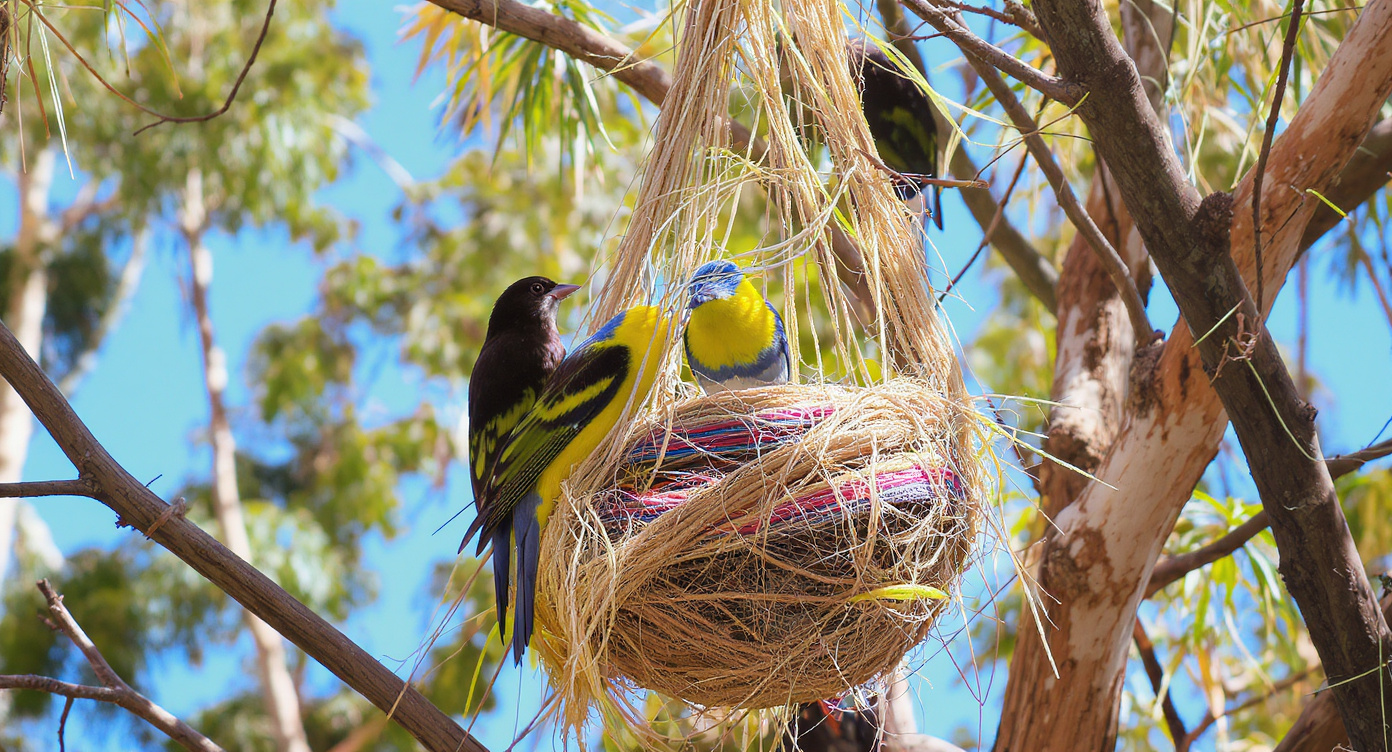
The experiment revealed that individual male zebra finches display consistent color preferences when building nests, choosing fibers of a particular color. These birds can maintain their preferences even when most of their peers opt for a different color.
Zebra finches (Taeniopygia guttata) are small songbirds from the family of estrildid finches, native to Australia. They are known for their high social activity, nesting in colonies, and constructing intricate dome-shaped nests. In the wild, only males are responsible for nest building, and this process can occur once or several times a year, depending on environmental conditions.
In laboratory settings, zebra finches build nests year-round using colorful jute strings provided by researchers. It was observed that some males show a clear preference for a specific color, such as yellow, blue, or pink.
The study consisted of three stages. First, researchers determined each male’s color preference by observing how much time he spent near bundles of strings of different colors. Some birds spent up to 95% of their time with one color, others divided their time more evenly, and some showed no strong preference at all.
Next, males with pronounced preferences, along with females, were placed in a cage where four other pairs of finches had already built nests using fibers of a specific color. In some cases, all nests were made from the preferred color, in others—from a less favored one. For three days, the male could observe these nests and the behavior of other birds, after which he was given materials of both colors to build his own nest.
The results showed that males with weak color preferences were more likely to follow the majority and use the color most common in the surrounding nests. In contrast, males with strong preferences tended to stick to their choice, ignoring the influence of the group.
All males paid attention to social information—specifically, which color other birds used. This was evident in their initial behavior: if most birds used a less favored color, males often chose that material first, though this did not always lead to a change in their overall preference.
Thus, when building a nest, the balance between social influence and the strength of individual preferences plays a decisive role. The stronger the personal preference, the more likely a male is to stick with it, despite group pressure.
Future research aims to explore how the behavior of females, who actively participate in the process by sorting and rearranging materials and sometimes even discarding them, affects the choice of nesting material.