

An Australian sets a new record by accelerating a drone to 661 km/h
Australian engineer Benjamin Biggs has set an unofficial speed record for battery-powered quadcopters, accelerating his drone to 661 km/h. His achievement marks a new milestone in engineering competition and demonstrates the limits of modern technology in the race for speed.
Ingenium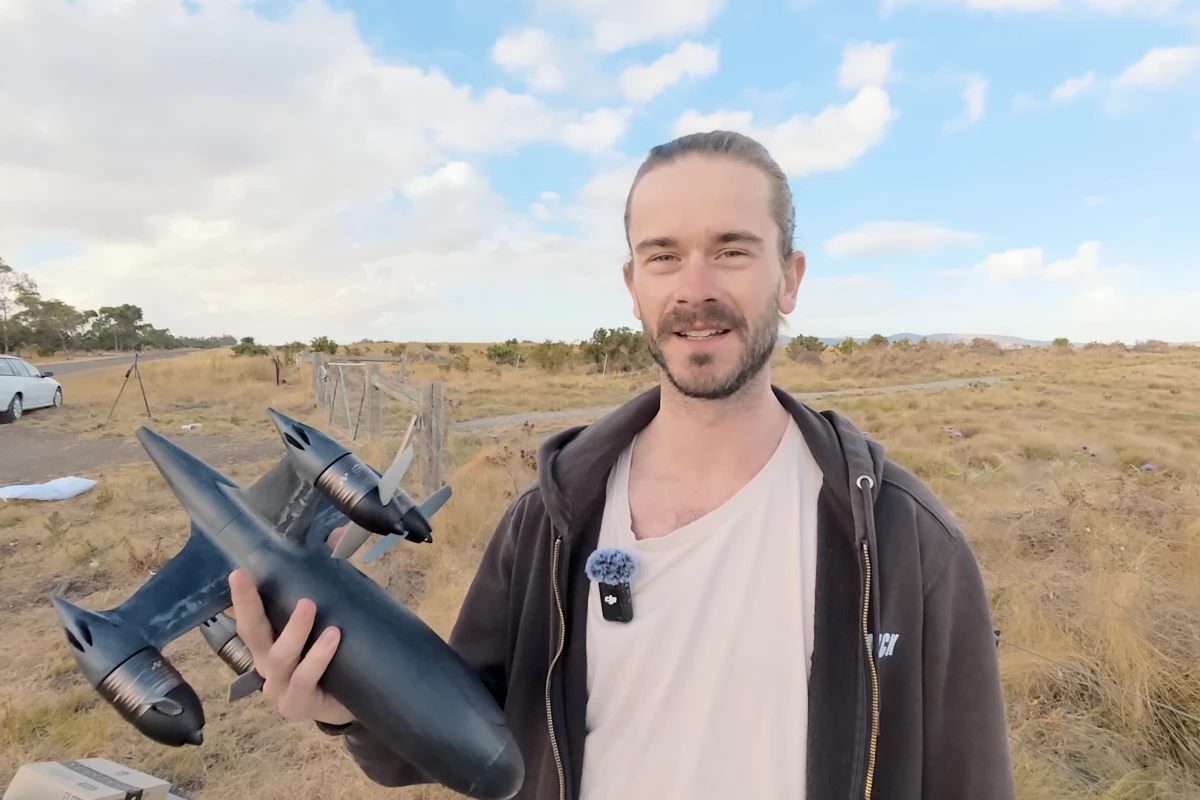
Australian aerospace engineer Benjamin Biggs has recently set a new unofficial speed record for battery-powered, remotely piloted drones, accelerating his drone to 661 km/h (411 mph). While the Guinness World Records has yet to confirm this achievement, it already surpasses the previous record set by the South African team of Mike and Luke Bell.
The Race for Speed: Engineers in Competition
The rivalry between Biggs and the Bells has turned into a true race for speed. It all began in May 2024, when Bell’s Peregrine 2 drone reached a speed of 482 km/h (300 mph). In the following months, the record was rapidly broken: 585 km/h (363 mph) in October 2025, 626 km/h (389 mph) in December, and 656 km/h (408 mph) in early January 2026. In response, Biggs developed a new drone from scratch, which managed to hit 661 km/h (411 mph).
Biggs notes, “Just a couple of weeks after we set our new world record, Luke broke it. We couldn’t let that stand!”
How the Record Run Was Made
To comply with Guinness rules, Biggs completed two runs: one with the wind (635 km/h, 395 mph) and one against it (690 km/h, 429 mph). The average speed was 661 km/h (411 mph) over the required 100-meter stretch. However, due to logistical issues on Thursday morning, certified professional drone pilots could not be present, so the record remains unofficial for now.
The Technical Secrets Behind the Speed
Achieving such high speeds was possible thanks to a careful balance between motor power, battery output without overheating, and minimizing aerodynamic drag and weight. Biggs uses two SMC 7S batteries with a capacity of 6000 mAh each, connected in series to create a 14S configuration. This allows the same power to be delivered at a lower current, reducing heat. Additionally, the batteries are charged to 4.35 V per cell instead of the standard 4.2 V, maintaining higher voltage under load and increasing motor RPM.
Drone Design Features
Unlike traditional layouts, Biggs opted for a front-motor (“puller”) configuration so the propellers operate in clean airflow, not in the turbulence from the frame. Specially wound AAX 2826 Competition motors have extended leads that run through the drone’s arms and are soldered directly to the speed controllers, eliminating excess wiring and allowing for slimmer arms. The Blackbird propellers were shortened to achieve even higher top speeds.
During the record run, the motors spun at 34,000 RPM, and the battery voltage dropped to 3.1 V per cell at peak speed. After landing, the batteries retained an 8% charge, and the temperature was a relatively cool 76 °C.
Future Prospects and Limits of Development
In the Guinness category, only battery-powered, remotely piloted quadcopters are allowed—a technological niche where 661 km/h is already an impressive feat. The question remains: will the Bells respond with an even faster Peregrine V5 before Biggs officially registers his record, or will the Australian engineer push his result even further?
Each new generation of designs pushes the boundaries of what lithium-ion batteries and propellers can achieve in dense air at low altitude. However, given the relatively small speed increase of the Blackbird compared to the current official record, one has to wonder—has this race for aerial supremacy reached the limits of modern technology?