

The Chinese have developed a gadget controlled by eye movement.
Chinese researchers have introduced a device that enables people with limited mobility to control computers and VR content using eye movements and power generated by blinking. The new device is lightweight, biocompatible, and could significantly improve the lives of users with motor impairments.
Ingenium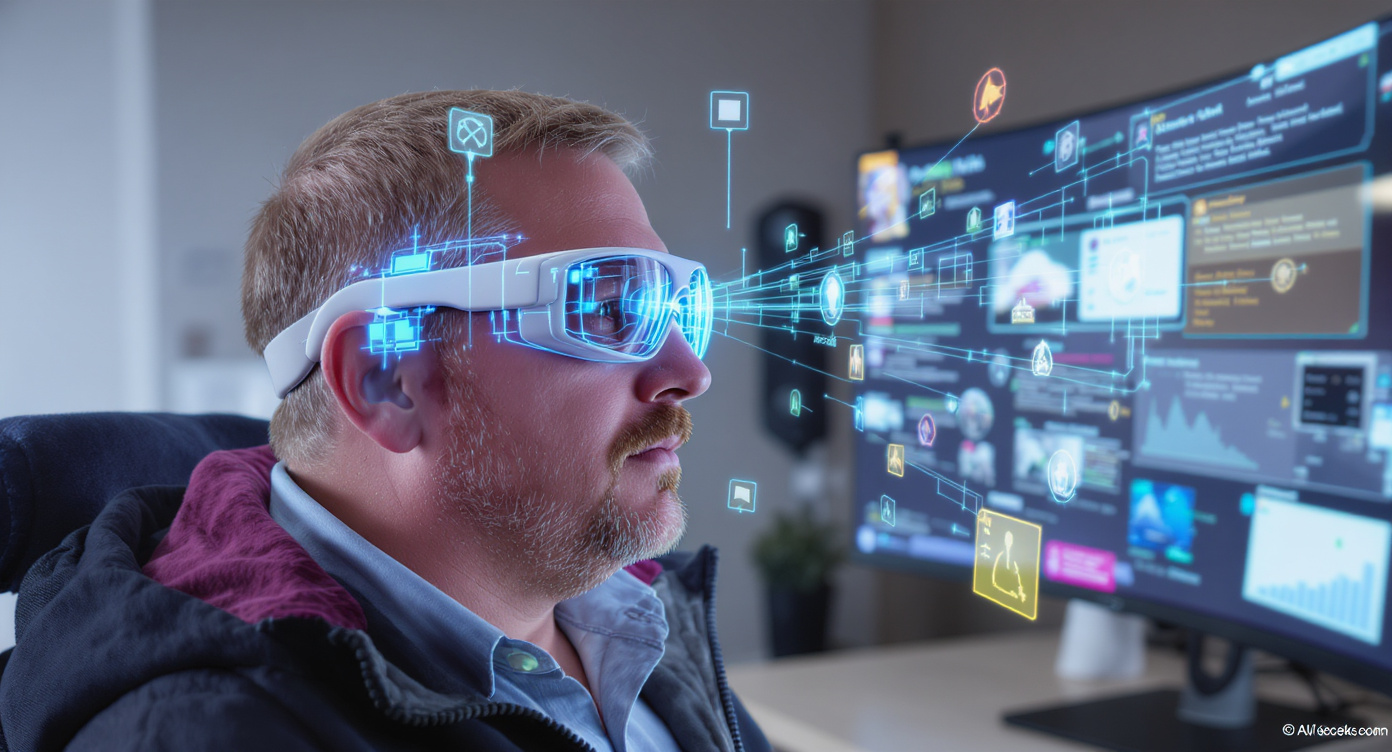
A team of Chinese researchers has unveiled an innovative device that enables people with limited mobility to control computers and view VR content using only their eye movements. What makes this gadget unique is that it is powered simply by blinking.
New Opportunities for People with Disabilities
The developers believe their device could replace current systems that rely on external power sources and often cause eye fatigue. The new device is as lightweight as regular glasses, making it much more comfortable than bulky alternatives. This solution could be especially beneficial for people with amyotrophic lateral sclerosis (ALS), who face significant challenges using their limbs and fine motor skills.
How the System Works
The wearable system tracks even the smallest movements of the eyeball and accurately converts them into commands. For example, a user can move the cursor across the screen simply by shifting their gaze, scroll through text in a VR environment, or even control a wheelchair—all accomplished solely through eye movements.
Technology and Design
The core component of the system is an ultra-thin, flexible layer of transparent, skin-safe PDMS plastic, worn on the eye like a contact lens. When the user blinks, the lens rubs against the eyelid, generating a small amount of static electricity. Special glasses with lenses coated in transparent sensors—substrate electrodes made from ITO material—are also used. These sensors are positioned to detect electrical signals produced when the eye moves in different directions.
The system operates on the principle of a triboelectric nanogenerator (TENG), which converts mechanical movement into electricity using static charge—similar to how a balloon rubbed against hair sticks to a wall.
Signal Processing and Control
The glasses are connected to a small signal processing unit that filters out noise, amplifies the signal from the tracker, and translates it into specific commands, such as "turn left" or "move the cursor up."
How It Works
Each time the user blinks, their eyelid rubs against the PDMS contact lens, causing a negative static charge to build up on the lens surface. After charging, the lens retains the charge for a considerable time—up to 10 minutes after a single blink. When the eye moves up, left, or right, the accumulated charge moves along with the eyeball.
When the charged lens approaches the sensors on the glasses, electrons move within the sensors due to electrostatic induction, creating a small electrical impulse. Thanks to the grid-like arrangement of the sensors, the system can precisely determine the direction of the gaze based on which sensor detected the impulse.
Testing and Future Prospects
The system was tested on a live rabbit and with a set of mechanized eyeball simulators. Experiments showed that the "eyes" could move in different directions and scroll text—much like how it would work in VR.
Researchers noted that the friction layer effectively retains charge in biological conditions on the rabbit's eye, and the system demonstrates high accuracy even in strong electromagnetic interference.
This is likely the first device of its kind powered by blinking. The choice of materials and design already make it biocompatible and almost unnoticeable, and with future commercialization, it could become even more user-friendly. The team hopes the technology will find applications in astronaut equipment, intelligent driving systems, and various solutions for people with disabilities, allowing them to use gadgets in the near future.