

Hydromax sets a world speed record on hydrogen
The JCB Hydromax hydrogen car has set a new world speed record among eco-friendly vehicles, reaching a top speed of 653.91 km/h on the Bonneville Salt Flats. This achievement demonstrates the potential of hydrogen engines for both mass production and extreme performance applications.
Vectus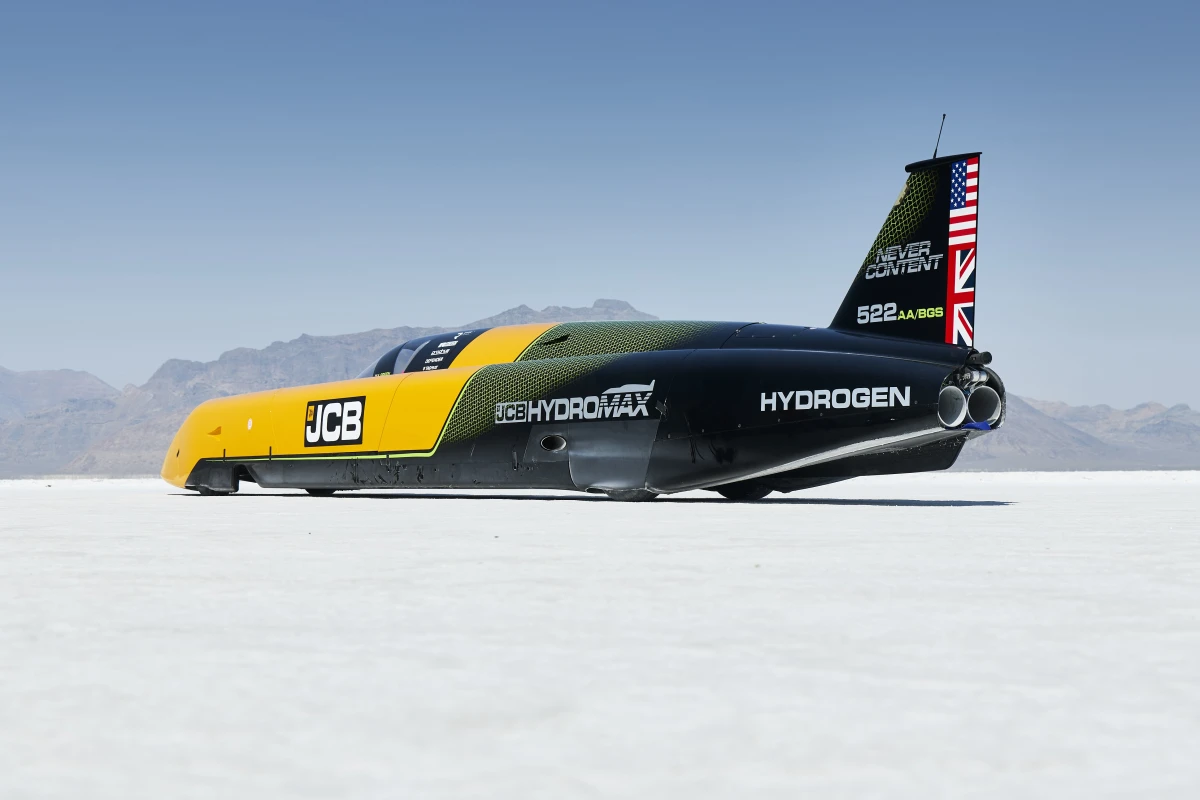
Just a few days after reaching a speed of 368.347 mph (592.797 km/h), the hydrogen-powered JCB Hydromax set a new world speed record according to the Fédération Internationale de l'Automobile (FIA), accelerating to 406.320 mph (653.91 km/h) on the Bonneville Salt Flats. This achievement made the Hydromax the fastest hydrogen car and the fastest zero-emission vehicle in history.
Breaking Previous Records
During the run, the previous record for diesel cars was also surpassed. That record, set twenty years ago at the same location by the JCB Dieselmax, stood at 317 mph (510 km/h). Both records were achieved by the same driver—Squadron Leader Andy Green.
Details of the Run
Green returned to the Bonneville track, pushing the JCB Hydromax to 400.623 mph (644.74 km/h) in one direction and 412.135 mph (663.27 km/h) on the return, resulting in an average speed of 406.320 mph.
Green also holds the absolute world land speed record—763.035 mph (1,227.99 km/h)—set in the jet-powered ThrustSSC. He remains the only person to have broken the sound barrier on land.
Hydromax Technical Specifications
The 32-foot-long (9.75 m) Hydromax features all-wheel drive via a dual transmission and clutch system. The car is powered by two upgraded JCB hydrogen internal combustion engines, originally developed for construction equipment. Each engine produces 800 hp, delivering a combined output of 1,600 hp and powering both axles.
JCB notes that these engines are similar to those already used in the company’s construction machinery. The development of hydrogen technology is part of a £100 million initiative. When hydrogen burns, it emits only water vapor and a small amount of nitrogen oxides, making these engines a low-emission alternative to gasoline and diesel.
Significance of the Record and Future Prospects
The record was set just before the opening of JCB’s new $500 million plant in San Antonio, Texas. The Hydromax also outpaced the Buckeye Bullet 3 electric car, which achieved an average speed of 341.264 mph (549.21 km/h) at Bonneville in 2016.
This run demonstrates that hydrogen internal combustion engines can withstand extreme loads, and that a technology once considered experimental is now becoming a viable direction for mass production. The Hydromax proves that hydrogen engines can be not only practical but also exceptionally fast.