

Octopuses have learned to use mirrors for hunting.
A new study has shown that octopuses are capable of using mirror reflections to locate prey outside their field of vision—something previously thought possible only for mammals and birds. The experiment confirmed the advanced cognitive abilities of these cephalopod mollusks.
Cursus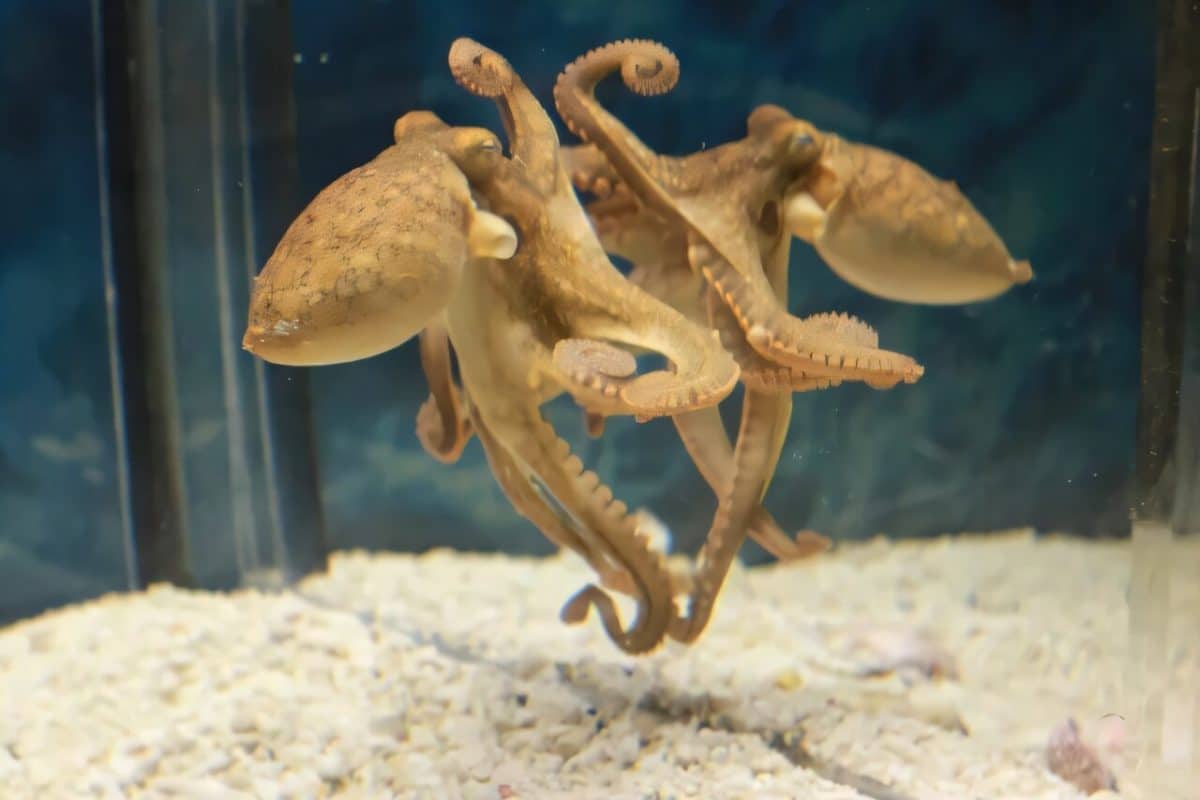
Scientists have recorded yet another confirmation of advanced cognitive abilities in octopuses. During experiments, these cephalopod mollusks successfully learned to use mirror reflections to locate prey that was outside their direct line of sight. Previously, it was believed that only certain mammals and birds were capable of solving such tasks.
In recent years, biologists have noted that octopuses display a high level of intelligence among cephalopods. These animals can use objects to build shelters, solve complex problems such as navigating mazes and opening containers with food, possess well-developed short-term and long-term memory, and are even capable of learning by observation.
A new study conducted at Dartmouth College (USA) has expanded our understanding of the cognitive abilities of octopuses. In the experiment, three California two-spot octopuses (Octopus bimaculoides) were trained to determine the true location of prey reflected in a mirror and to move toward it, rather than attacking the reflection itself.
Initially, the octopuses were acclimated to the presence of a mirror in their aquarium. Then, they were shown a live crab inside a glass jar, which could only be seen in the mirror. At first, the mollusks tried to attack the reflection, but after several attempts, they began to move toward the jar with the crab to get the food. Each animal needed 10–12 tries to master this skill.
In the next stage, the task became more challenging: a virtual image of a crab was projected onto a semi-transparent screen attached to the outside of the tank’s back wall, and the mirror was positioned to reflect this image. The octopus was placed in a box with a limited view so it could only see the crab’s reflection. After 30 seconds, the reflection appeared on one side of the screen. To receive a reward, the octopus had to turn 180 degrees and move to the corresponding side of the back wall of the aquarium, without approaching the mirror. In 73% of cases, the animals chose the correct direction.
The results of the experiment showed for the first time that invertebrates are capable of establishing a connection between a mirror reflection and the real location of an object. Previously, it was thought that such spatial perception skills were unique to vertebrates—certain mammals and birds. Like novice drivers learning to use a rearview mirror to track objects, octopuses can use mirrors to determine the position of items in their environment.