

The Spanish platform is testing wave energy.
In Spain, tests are underway for the MARMOK-A-5 device, which converts the energy of ocean waves into electricity for residential homes. The technology shows promise but still requires further development before it can be widely implemented.
Vigor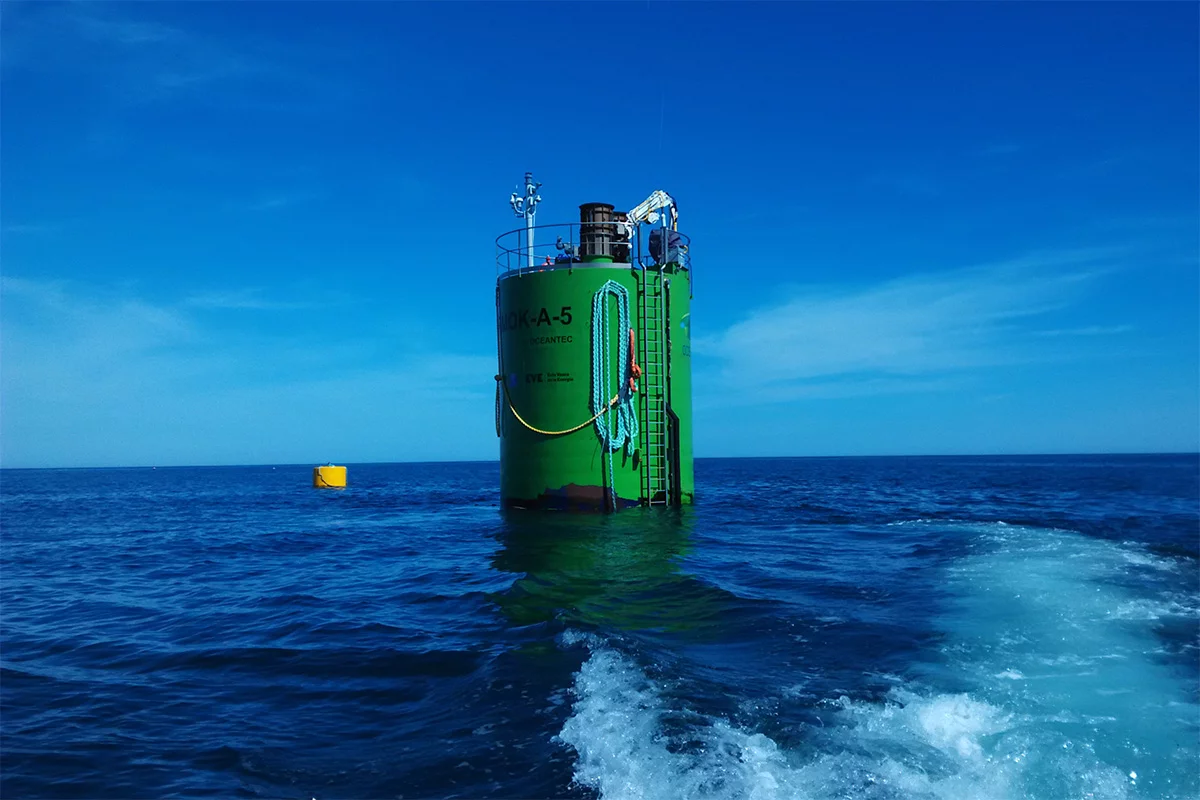
Harnessing the energy of ocean waves to generate electricity is a complex engineering challenge. In northern Spain, at the Biscay Marine Energy Platform (BiMEP), the Bilbao-based company IDOM has been testing a low-power wave energy converter (WEC), a project that has been in development for several years.
Design and Operating Principle
The device, named MARMOK-A-5, is a point absorber with an oscillating water column (OWC). Its structure resembles a buoy with a cylindrical water column inside, standing 42 meters tall, of which about 5 meters rise above the water’s surface. The buoy has a diameter of 5 meters and is anchored to the seabed at a depth of nearly 90 meters.
Waves surrounding the MARMOK-A-5 cause the water inside the column to move relative to the buoy. This movement compresses and expands an air chamber at the top of the structure, creating a reciprocating airflow that drives a turbine. The generated electricity is transmitted to the shore grid via an underwater cable. The prototype can produce up to 30 kW of electricity, enough to power 15–20 average homes during peak periods.
Testing and Technology Development
Early versions of this technology have been deployed at sea since 2016 and have successfully withstood winter conditions. The latest modification is equipped with intelligent control systems, adjustable blades, and built-in batteries. The device is designed to demonstrate the efficiency of electricity generation in real marine environments.
After successful installation and grid connection at the BiMEP platform, the next step will be full-scale operation. Data collected during testing will be used to further refine the technology before commercialization and large-scale deployment.
Outlook and Other Projects
In 2024, a massive 826-ton OE-25 device from Ocean Energy was installed off the coast of Oahu, Hawaii. That same year, the University of Western Australia began testing a new WEC design in King George Sound, and Danish company Wavepiston signed a memorandum to launch a 50 MW WEC installation for Barbados.
Despite the significant potential of wave energy in the ocean, developing scalable systems to convert it into electricity remains a major challenge. It is essential to design installations that can withstand harsh marine conditions, ensure reliable maintenance, make operation economically viable, and minimize impacts on marine ecosystems.