

Single-celled organisms have demonstrated the ability for associative learning.
An experiment with the ciliate Stentor coeruleus has shown that single-celled organisms are capable of associative learning, even in the absence of a nervous system. This discovery suggests that complex forms of behavior have ancient evolutionary origins.
Cursus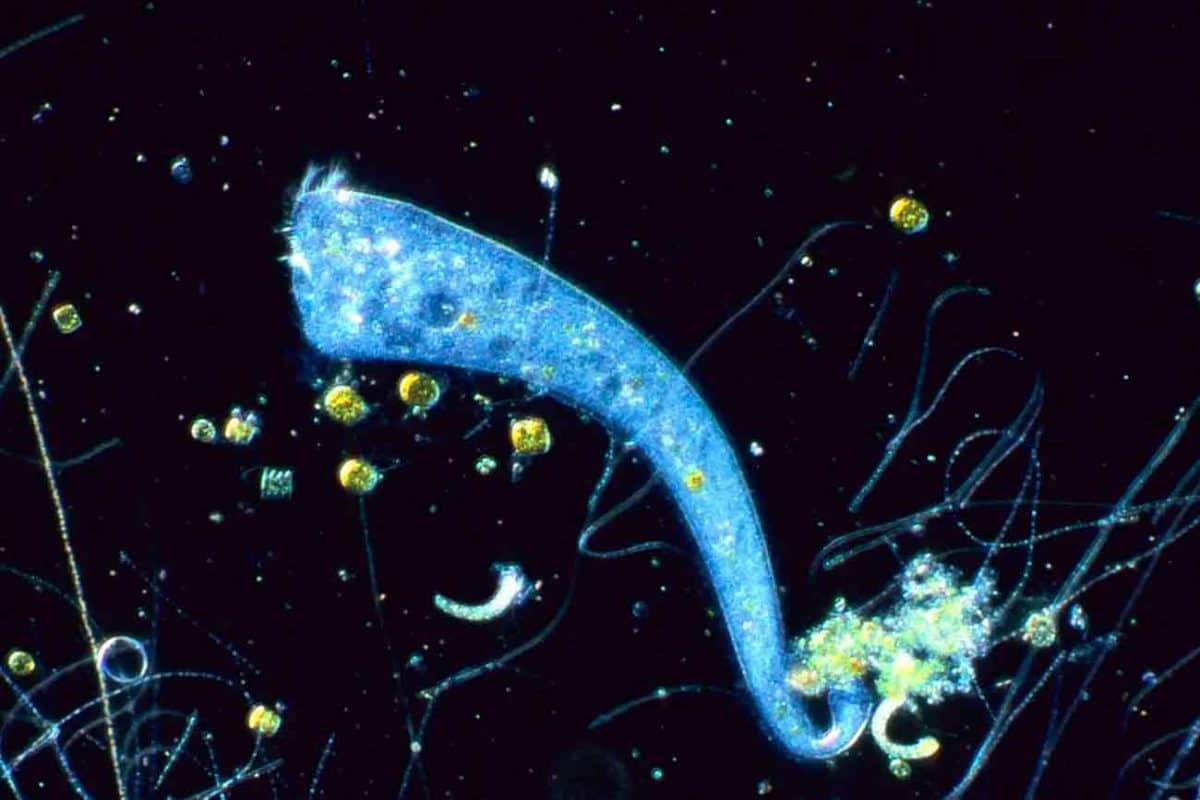
A tiny inhabitant of freshwater bodies, the ciliate Stentor coeruleus, has demonstrated signs of associative learning, despite lacking a brain or nervous system. Experiments have shown that these single-celled organisms are capable of linking events and anticipating that one will follow another. This suggests that associative learning may have arisen long before the appearance of nervous systems in multicellular organisms.
Forms of Learning in Single-Celled Organisms
For a long time, biologists debated whether single-celled organisms could learn from their own experiences. The simplest form of learning is habituation, where an organism stops responding to a repeated and harmless stimulus. Such behavior has been observed in some plants, protozoa, and animals.
A more complex form is associative learning, in which an organism connects two events and begins to perceive one stimulus as a signal for another. The classic example is Pavlov’s experiment with dogs, where the animals started to salivate at the sound that preceded feeding.
It was previously believed that at least a primitive nervous system was necessary for associative learning, so single-celled organisms were considered incapable of this type of learning.
The Stentor coeruleus Experiment
A team of American biologists conducted an experiment with Stentor coeruleus, a ciliate that lives in freshwater. This organism has a tubular shape less than a millimeter long, attaching to surfaces on one end and equipped with a ciliated mouthpart on the other for filtering food.
When threatened, Stentor coeruleus triggers a defensive reflex: special fibers along the cell contract instantly, causing the entire cell to shrink into a tight ball, stopping both water filtration and feeding.
Experiment Procedure
In the first phase, researchers delivered strong taps to the bottoms of Petri dishes containing the ciliates. The initial taps caused most cells to contract immediately, but with repeated exposure, the response weakened—the ciliates became accustomed to the stimulus.
The experiment was then made more complex: a weak tap was delivered first, followed by a strong tap a second later. These signal pairs were repeated every 45 seconds. Scientists recorded how many cells contracted in response to the weak tap before the strong one occurred. At first, the number of reacting cells increased sharply, indicating the formation of an associative link between the weak and strong stimuli. Over time, the response again diminished as the cells became accustomed to the sequence of signals.
A control test showed that when only the weak signal was given, without a subsequent strong tap, almost no contractions were observed. This confirms that the weak tap became a warning of impending danger for the cells, not just a simple irritant.
The Role of Signal Intervals
The effectiveness of learning depended on the interval between the weak and strong taps. If the gap was too long, the cells "forgot" the connection between events, and learning was less effective. If the signals came too frequently, the cells didn’t have time to recover, and their response also decreased. Thus, the frequency of signal repetition directly affects the ciliate’s ability to anticipate danger.
Memory Mechanisms in Single-Celled Organisms
The ability to learn in complex ways suggests the presence of a memory mechanism. It is believed that the ciliate’s membrane contains receptors that respond to touch. When activated, calcium ions enter the cell, changing its internal voltage and causing contraction. With repeated signals, some receptors alter their function, acting as molecular "switches" that can block the alarm signal if the cell’s internal biochemistry "decides" the threat isn’t real.
The Significance of the Discovery
The results of the experiment point to the ancient origins of associative learning. Complex behaviors may have emerged long before the first multicellular organisms with primitive nervous systems appeared. It is thought that ancient molecular mechanisms, inherited from single-celled ancestors, still operate within human neurons, allowing them to "learn" from incoming signals even without changes in connections between cells—at the level of basic cellular processes.
Publication of Results
The researchers’ findings are available on the biology preprint server bioRxiv.