

Chimpanzees can distinguish crystals and show interest in them.
Experiments have shown that chimpanzees can distinguish crystals from ordinary stones and display a special interest in them, examining their geometry and transparency. This behavior is believed to be linked to the ancient roots of symbolic thinking in primates.
Cursus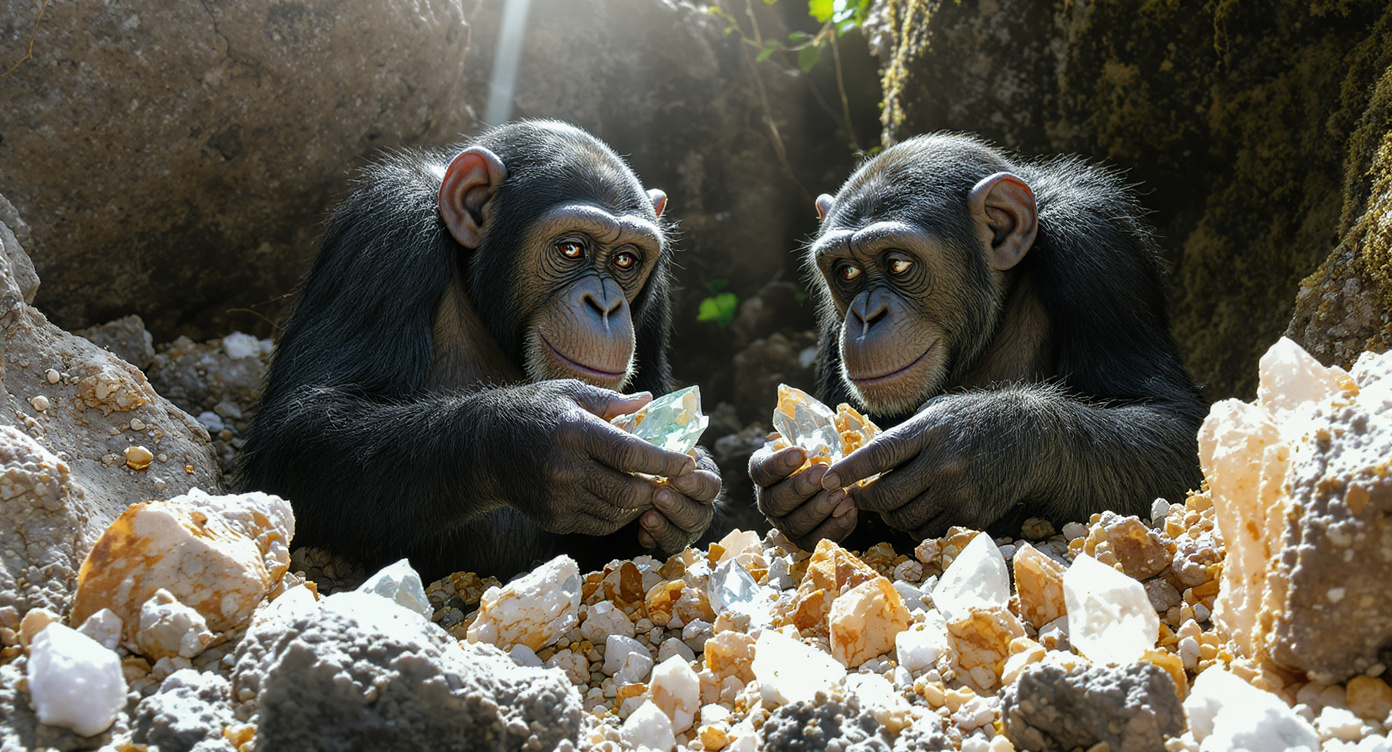
Chimpanzees were able to reliably distinguish crystals from ordinary stones and showed interest in their optical properties, spending a long time examining them. Biologists link this behavior to the archaeological phenomenon of ancient hominids collecting quartz. The attraction to precise shapes and transparency is considered an ancient evolutionary trait that preceded the development of abstract thinking.
At archaeological sites up to 800,000 years old, researchers regularly find untouched quartz and calcite crystals. Ancient humans brought them from afar but did not use them as tools, weapons, or ornaments—there are no traces of processing or holes for wearing. These objects were collected without practical purpose, which anthropologists see as one of the earliest signs of symbolic thinking.
During the study, scientists tried to determine which physical properties of minerals attracted hominids. To do this, they conducted two experiments with nine chimpanzees living in a Spanish nature reserve.
The “Monolith” Experiment
In the first experiment, two pedestals were placed in the enclosure: one held a transparent quartz crystal, the other an ordinary piece of sandstone with smooth edges. The researchers recorded the time and nature of the chimpanzees’ interactions with each object.
The Second Experiment
In the second test, piles of river pebbles were scattered in the grass, with two or three crystals hidden among them: transparent quartz, semi-transparent calcite, and opaque pyrite shaped as a perfect cube. The goal was to see if the primates could find the minerals and which properties—shape, shine, or transparency—they focused on.
Experimental Results
In the “Monolith” test, the chimpanzees quickly lost interest in the sandstone but continued to examine the quartz. One male even took a three-kilogram crystal to the sleeping area, where the group manipulated it for two days, turning it in their hands and observing it in the light. To retrieve the stone, researchers had to spend several hours trading treats with the chimpanzees.
In the second task, the apes quickly and accurately found the crystals among the stones. One female even sorted the found items: she put the round pebbles in one pile and all the crystals in another, highlighting their geometric regularity despite differences in color and transparency.
Reasons for Interest in Crystals
The researchers note that the natural environment mainly consists of fractal forms—winding rivers, uneven stones, and curved branches. Crystals, on the other hand, are unique objects with perfect straight lines, flat faces, and precise angles. Encountering such a visual anomaly could serve as a cognitive trigger for ancient primates.
Attention to transparency and geometric regularity likely contributed to the development of spatial perception long before humans began making symmetrical tools. However, the scientists also point out the experiment’s limitations: the sample consisted of only nine individuals, all raised in close contact with humans and artificial objects.