

Hanwha Ocean accelerates the standardization of offshore platforms
South Korean company Hanwha Ocean is implementing a standardization strategy for floating production storage and offloading units (FPSOs) to increase efficiency and shorten project delivery times. The company is strengthening its position in the global market, reporting significant profit growth and participating in new offshore projects.
Petrus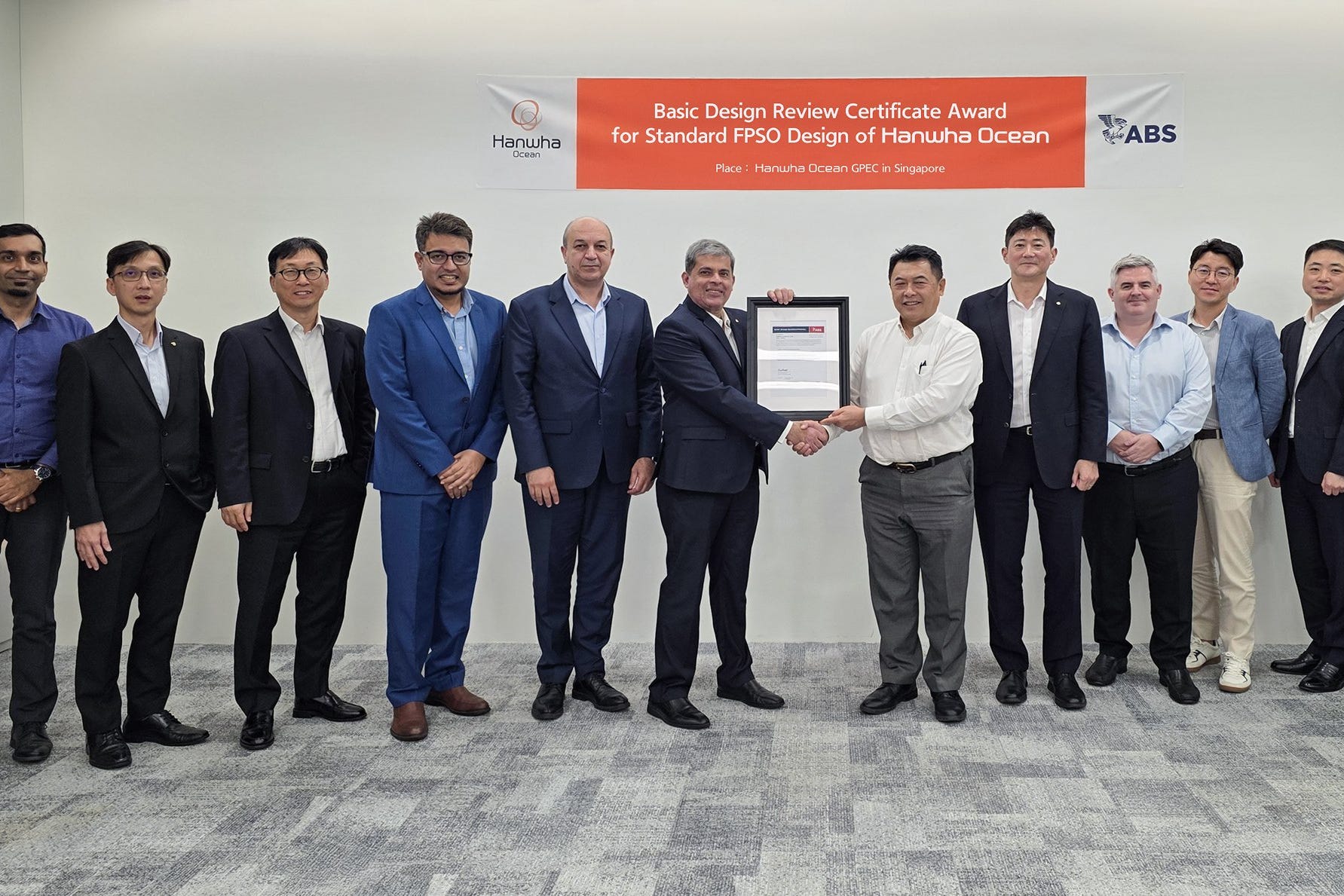
South Korean company Hanwha Ocean is developing a standard floating production, storage, and offloading unit (FPSO) at the basic design (FEED) stage.
Hanwha Ocean, one of the largest players in the offshore industry, has received a Basic Design Review (BDR) certificate from the American Bureau of Shipping (ABS) and a preliminary approval (AiP) from Norwegian company DNV. The certification covers key FPSO design elements, including the hull, marine systems, topsides, and mooring systems.
FPSO Standardization Strategy
The company is implementing an FPSO standardization strategy aimed at moving away from custom designs for each project. This approach increases the efficiency of engineering, procurement, and construction processes, enhances cost competitiveness, and shortens project delivery timelines.
Hanwha Ocean plans to strengthen its position in the global FPSO market by offering optimized solutions tailored to the specific needs and requirements of key offshore regions. This is part of a broader strategy to position itself as a full-cycle EPCIO (engineering, procurement, construction, installation, and operation) player, rather than just a construction company. The company also plans to integrate digital technologies into its FPSO business.
Project Development and Financial Performance
In 2024, Hanwha Ocean received preliminary approval (AiP) from ABS for its standard FPSO design at the pre-FEED stage, intended for deepwater operations in West Africa.
In the second quarter of 2026, the company recorded a significant increase in net profit—up to 693 billion won (USD 472 million), more than triple the figure for the same period last year. The EPU division posted an eightfold increase in quarterly revenue, reaching 2.07 trillion won (USD 1.4 billion), as well as an operating profit of 6 billion won (USD 4 million). The company attributed these results to revenue recognition from completed projects and measures to restore profitability.
Outlook and Participation in New Projects
Hanwha Ocean expects continued investment in the extraction sector by operators amid geopolitical uncertainty and oil price volatility driven by the situation in the Middle East.
The company is also a contender to supply a floating production unit (FPU) for the Aphrodite gas project off the coast of Cyprus and is competing for the FPSO Venus project off the coast of Namibia. In March, Hanwha Ocean signed a contract to build topsides for the Leviathan platform off the coast of Israel.